22 May 2012

Skills, Expanded

I wrote before about the seven skills a leader is rated in. But we wanted to support OSL code such as

test Deception(expeditionLeader) vs Crankiness d6

In other words, like many roleplaying games, people have all sorts of abilities. But seven was already a fairly large number. So we came up with the idea of composite skills. Deception is the average of Bargaining and Leadership.

Including the composite skills, a leader can be tested in
Animals
Bargaining
Combat
Custom
Deception (Bargaining + Leadership)
Diplomacy (Bargaining + Custom)
Exploring (Bargaining + Combat)
Farming (Animals + Plants)
Hunting (Animals + Combat + Plants, special for Odayla worshippers)
Leadership
Magic
Plants
Poetry (Custom + Leadership)
Prophecy (Magic + Leadership)
Strategy (Combat + Leadership) 
Note that not every attempt to compose a poem is automatically use of the Poetry skill — it would depend on the context. But without some obvious reason to do things differently, that’s how we would have coded the scene.

15 May 2012

Still Not Universal

Unfortunately, there isn’t a lot of progress to report on the Universal build of King of Dragon Pass. Due to unforeseeable issues, our artist wasn’t able to complete the work. We’ve arranged for another artist.

Since we sometimes get asked: we are making a Universal build. That is, a single app that will run on iPhone or iPad, and take advantage of the screen size of each. If you already have the app on an iPad, it will be a free update.

(While the game doesn’t fill the screen of the new 3rd generation iPad, that device does use its Retina Display to display text, so the game looks very nice when blown up to 2x.)

We’ll let you know when there’s more progress.

24 March 2012

News: Sale(s), Move


We here at A Sharp have a couple pieces of news to share.

King of Dragon Pass for iOS has sold 15000 copies! We don’t have an exact count for the original (the second printing sold slower and our record-keeping got worse as time went on), but this is several times as many copies as we sold for the CD-ROM version. Thank you all so much for trying the game, and letting your friends know so they’d give it a try. Obviously this is not as many copies as Angry Birds has sold, but it’s not the same sort of game. And we’re really pleased that so many people have enjoyed it.

To celebrate, we’re putting the game on sale for 20% off until 1 April!

The other news is a bit different. With David’s new job as Development Manager at Shenandoah Studio, we will soon be relocating to Philadelphia. Hopefully this won’t result in any interruption of our web server (which is currently in the house where we created King of Dragon Pass). It will mean we’ll be a bit slower to respond before, during, and after the move.

And this isn’t news at all: we don’t have anything to report on the Universal version of King of Dragon Pass. At least on the new iPad, the text looks wonderful even when you magnify the iPhone screen to 2x (this wasn’t the case with the previous iPads). We still intend to release a Universal build when the art’s ready.

28 February 2012

A Taste of QA

While cleaning up the house (King of Dragon Pass was created in our home office), I ran across a notebook kept by Rob Heinsoo, our QA lead. Here’s a typical page:

While for the most part we avoided the branching problem, King of Dragon Pass still had a lot of content, and we wanted to make sure each response of each scene was tested. Most of these had success and failure results, so our QA team had to keep track of when these happened. (It was possible to force things to happen, but I think our preference was to have them come up naturally, since in many cases things depend on something that happened earlier. Forcing a scene or outcome might be buggy in its own right.) Note that a scene might behave differently depending on clan status, e.g. R288 depends on morale.

The new scenes in 2.0 went through a similar process to make sure every branch and outcome worked.

18 January 2012

Regional Variation

It’s interesting to look at some of the sales figures. Denmark just became our number 9 market (with 1.61% of revenue), edging out Norway. This appears to be largely due to a single review (I don’t know if this is an online review or also appeared in print).

This is a bit like the original version of King of Dragon Pass, where a review in the print magazine Pelit made the game a top 10 hit in Finland.

But it’s unlike Norway, where we got 50 sales in one day thanks to a single review (I suspect this was online only).

We can see the difference in these graphs. The bottom graph shows worldwide revenue by date. You can see the birthday sale, and the Sacred Time sale (and the overall effect of the holiday, which is to raise sales to a somewhat higher level — apparently there are a lot of new devices). The top graph shows Finland (orange), Norway (light purple), and Denmark (dark purple). All three Scandinavian countries have about the same population, so they’re interesting to compare. Sales in Finland more or less track worldwide sales, except for a bump when we got reviewed by the print magazines Pelit and Pelaaja. The effects of the Norwegian review are very obvious — but there is almost no long term change in the level of sales. Maybe nobody in Norway let their friends know about the game. But Denmark has a sales spike from the review, but then sales continue at a significantly higher level than before.

I don’t really have an explanation as to why these countries have such different responses to the game. But I think this does show that reviews are still an important way for people to learn about games.

01 January 2012

Looking Back

Although King of Dragon Pass has been available for iOS for less than a year (it was released on 7 September), this is a convenient time to look back.
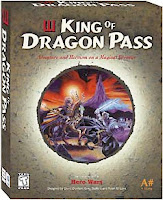
The KoDP box
The game began to take form in March 1996, or at least that’s the earliest document I could find (a proposal for the game). Full-time work began in January 1997, and the game finally shipped on 29 October 1999. We sold the game through hobby game distribution and through a web store. (We outsourced fulfillment, so we didn’t need to warehouse thousands of boxes.)

Thanks in part to strong sales in Finland, we made a second printing. Our records aren’t as clear as they might be, so I don’t know when we shipped the last box (probably 2006). I do know it was to Finland.

Since some of my earliest ideas for a saga-style game had been intended for the Apple Newton, I was excited when the iPhone SDK finally came out. But since I knew King of Dragon Pass was a big project, my first iPhone game was Jigami (which I’d originally created for Newton).

Preliminary UI design
In June 2009 I started sketching out user interface to see how practical it would be to fit the game on a 480 x 320 pixel screen (recall that the original was 640 x 480 pixels, and buttons need to be much larger for a touch interface). In November I was doing some prototyping.

Coding of the app began 29 Dec 2009. The development diary shows a 5 month gap with no progress. Partly this was because I took time to do a much shorter project (DiceBook), but also I think I must have been unsure how the game would be received. But the diary notes favorable reaction from people I showed the game to, so I resolved to finish it.

Once I was pretty confident that the game would work and I’d be able to do it, I went public (August 2010). That’s when this blog began.

Unlike the original, the iOS version was a part time project (and essentially just one person), and thus the time scale was stretched out. For example, the game first hit alpha (feature complete, but buggy) in April 2011, and beta (known bugs fixed) in May. But polish and fixing bugs (including ones uncovered by iOS 5) took until August.

We submitted the game, and it was approved on 1 September. We sent out the news, and released the game on 7 September. Depending on how you count, it had been over 15 years in the making!

And it’s not done yet. The iPad hadn’t been released when we began the iPhone version, but we’re in the middle of doing a Universal build to take advantage of its larger screen.

Taking a different approach to looking back, in four months we’ve sold about twice as many copies from the App Store as we did boxes (over maybe six years). The game isn’t a smash hit (although it’s hit the top of the Role Playing Game category in both Finland and Denmark), but it’s apparently in the top 10% in terms of revenue according to Owen Goss’s survey.

Version 1.0.4 ratings
Another way of looking at it: did people enjoy the game? AppViz reports that version 1.0.4 has received 5 stars from 111 of 119 people who rated that release.

I’m also very pleased that we were able to make the game accessible to blind players.

So that’s a look at the game so far. I may take another look back, in the form of a post mortem report (writing up lessons learned). But I’m also starting to think about what might come next (after the iPad UI is done).

13 December 2011

People Like It

One thing that pleases me is that almost everyone who plays King of Dragon Pass likes it. If I recall correctly, only two people took us up on our money-back guarantee for the boxed copy. (One said he was a Christian and objected to the magic, which seemed odd given how we made an effort to promote the magical land of Glorantha.)

The relative percent is about the same for the iOS version. There have been a total of 6. Refunds are handled through Apple, but I know one person simply couldn’t get the game to work on their iPod touch.

One thing I was curious about was whether our sale lured people in who didn’t like the game. This chart shows that there’s no particular correlation.

The chart also includes the number of gift purchases and redemptions. The numbers aren’t the same — either people are waiting to send out the gift, or people forget to enter it into iTunes or the App Store.

(“Gift This App” appears in a popup menu in the App Store, if you know someone who has an iPhone, iPod touch, or iPad and needs a Christmas present.)

Ratings are also quite favorable. The current version has been rated 93 times, of which 85 are 5 stars. (5 are 4-star and 3 are 1-star.) And the reviews have been really good as well — 93 out of 100 on Metacritic.