18 January 2012

Regional Variation

It’s interesting to look at some of the sales figures. Denmark just became our number 9 market (with 1.61% of revenue), edging out Norway. This appears to be largely due to a single review (I don’t know if this is an online review or also appeared in print).

This is a bit like the original version of King of Dragon Pass, where a review in the print magazine Pelit made the game a top 10 hit in Finland.

But it’s unlike Norway, where we got 50 sales in one day thanks to a single review (I suspect this was online only).

We can see the difference in these graphs. The bottom graph shows worldwide revenue by date. You can see the birthday sale, and the Sacred Time sale (and the overall effect of the holiday, which is to raise sales to a somewhat higher level — apparently there are a lot of new devices). The top graph shows Finland (orange), Norway (light purple), and Denmark (dark purple). All three Scandinavian countries have about the same population, so they’re interesting to compare. Sales in Finland more or less track worldwide sales, except for a bump when we got reviewed by the print magazines Pelit and Pelaaja. The effects of the Norwegian review are very obvious — but there is almost no long term change in the level of sales. Maybe nobody in Norway let their friends know about the game. But Denmark has a sales spike from the review, but then sales continue at a significantly higher level than before.

I don’t really have an explanation as to why these countries have such different responses to the game. But I think this does show that reviews are still an important way for people to learn about games.

01 January 2012

Looking Back

Although King of Dragon Pass has been available for iOS for less than a year (it was released on 7 September), this is a convenient time to look back.
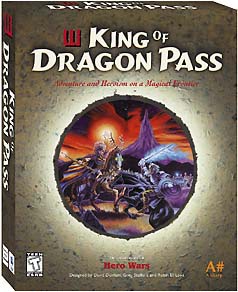
The KoDP box
The game began to take form in March 1996, or at least that’s the earliest document I could find (a proposal for the game). Full-time work began in January 1997, and the game finally shipped on 29 October 1999. We sold the game through hobby game distribution and through a web store. (We outsourced fulfillment, so we didn’t need to warehouse thousands of boxes.)

Thanks in part to strong sales in Finland, we made a second printing. Our records aren’t as clear as they might be, so I don’t know when we shipped the last box (probably 2006). I do know it was to Finland.

Since some of my earliest ideas for a saga-style game had been intended for the Apple Newton, I was excited when the iPhone SDK finally came out. But since I knew King of Dragon Pass was a big project, my first iPhone game was Jigami (which I’d originally created for Newton).

Preliminary UI design
In June 2009 I started sketching out user interface to see how practical it would be to fit the game on a 480 x 320 pixel screen (recall that the original was 640 x 480 pixels, and buttons need to be much larger for a touch interface). In November I was doing some prototyping.

Coding of the app began 29 Dec 2009. The development diary shows a 5 month gap with no progress. Partly this was because I took time to do a much shorter project (DiceBook), but also I think I must have been unsure how the game would be received. But the diary notes favorable reaction from people I showed the game to, so I resolved to finish it.

Once I was pretty confident that the game would work and I’d be able to do it, I went public (August 2010). That’s when this blog began.

Unlike the original, the iOS version was a part time project (and essentially just one person), and thus the time scale was stretched out. For example, the game first hit alpha (feature complete, but buggy) in April 2011, and beta (known bugs fixed) in May. But polish and fixing bugs (including ones uncovered by iOS 5) took until August.

We submitted the game, and it was approved on 1 September. We sent out the news, and released the game on 7 September. Depending on how you count, it had been over 15 years in the making!

And it’s not done yet. The iPad hadn’t been released when we began the iPhone version, but we’re in the middle of doing a Universal build to take advantage of its larger screen.

Taking a different approach to looking back, in four months we’ve sold about twice as many copies from the App Store as we did boxes (over maybe six years). The game isn’t a smash hit (although it’s hit the top of the Role Playing Game category in both Finland and Denmark), but it’s apparently in the top 10% in terms of revenue according to Owen Goss’s survey.

Version 1.0.4 ratings
Another way of looking at it: did people enjoy the game? AppViz reports that version 1.0.4 has received 5 stars from 111 of 119 people who rated that release.

I’m also very pleased that we were able to make the game accessible to blind players.

So that’s a look at the game so far. I may take another look back, in the form of a post mortem report (writing up lessons learned). But I’m also starting to think about what might come next (after the iPad UI is done).

13 December 2011

People Like It

One thing that pleases me is that almost everyone who plays King of Dragon Pass likes it. If I recall correctly, only two people took us up on our money-back guarantee for the boxed copy. (One said he was a Christian and objected to the magic, which seemed odd given how we made an effort to promote the magical land of Glorantha.)

The relative percent is about the same for the iOS version. There have been a total of 6. Refunds are handled through Apple, but I know one person simply couldn’t get the game to work on their iPod touch.

One thing I was curious about was whether our sale lured people in who didn’t like the game. This chart shows that there’s no particular correlation.

The chart also includes the number of gift purchases and redemptions. The numbers aren’t the same — either people are waiting to send out the gift, or people forget to enter it into iTunes or the App Store.

(“Gift This App” appears in a popup menu in the App Store, if you know someone who has an iPhone, iPod touch, or iPad and needs a Christmas present.)

Ratings are also quite favorable. The current version has been rated 93 times, of which 85 are 5 stars. (5 are 4-star and 3 are 1-star.) And the reviews have been really good as well — 93 out of 100 on Metacritic.

11 December 2011

A Skilled Leader

I’ve seen a few questions about the named leaders, so I’ll amplify a bit on what’s in the manual.

By the way, named leaders are considered nobles (thanes), and are counted as such in the Clan screen.

Each leader is rated in seven skills. These are actually numbers, but rather than report them as 3.3 or 5.12, they’re categorized
Fair
Good
Very Good
Excellent
Renowned
Heroic

Normally any skill less than Good isn’t listed, to make things easier.

In the normal course of events, leaders gradually improve, until age 50. Elders may lose their Combat edge as they get older. (Once in a while characters can lose — or gain — skill in other ways.)

So what are those skills good for?

The quality of the advice someone gives depends on their skills. For example, Vordessa (with Very Good in Animals) can probably give reasonable advice about situations involving cattle health. But someone with a Renowned skill will probably have additional insights. The game favors the best advice, so depending on the situation, Vordessa will more often be giving Combat advice (since it’s Excellent) rather than Animal-related advice.

Leaders are sometimes explicitly tested in their skills. For example, the “Uralda’s Blessing” heroquest is hard because the quester must have a good enough Combat skill to survive the biting things. Or an interactive scene may let you pick who fights a duel or acts as an emissary. Depending on the situation, the game may only let you choose from characters who are likely to succeed. For example, if you won’t succeed unless you have a good bargainer, the “pick leader” dialog will only show characters above a certain level. (What skill is tested is not always obvious, and in fact more than one skill may be important, so you might want to sort the list several ways before picking.)

Leaders are also tested when they act as the clan’s agent. When you pick a response, somebody actually has to perform (or lead) the action. For example, this OSL code

Response 5: “We will go with you, but your clan will owe us a favor.”
{
# Calculate clan relationship bonuses
test Bargaining vs. Bargaining d5 + 1 + n, bonus: b

means that the leader with the best Bargaining skill makes the test on behalf of the clan. (The second “Bargaining” indicates that certain treasures or magic come into play.)

So the skills are quite important. You want leaders on the ring who can give you good values in each of the seven skills.

On the other hand, you also want seven different religions represented on the ring. This matches Orlanth’s first ring, and thus gives magical benefit. There are also times when a leader’s religion gives you additional options, like in this OSL code

[UroxOnRing] Response 6: Conduct a ritual to sense Chaos.

So picking a clan ring is a tradeoff.

Finally, no discussion of clan leaders should leave out their personalities. Everyone is an individual, with an aptitude for poetry, hatred of elves, or a solitary streak. This will color their advice (as they can’t resist from promoting their agenda), or drive their actions. Check out any statements a leader makes when you tap them in the Reorganize dialog, or watch for trends in their advice.

05 December 2011

Regional Variation

As I’ve mentioned before, King of Dragon Pass is big in Finland (right now in the App Store it’s the top selling Role Playing game and top grossing Strategy game). Finland has remained our number three market (after the far more populous USA and UK).

One change since last month is that Germany is now #6 and Singapore is now #10. The number are all close, but since this is total sales, this may be statistically significant.

The map makes it real obvious that we have very few sales in Africa or Mongolia (not surprising), but also none in Brazil (which does seem odd to me, since there is an App Store).

One item of interest is that sales in different regions don’t move in lockstep. The chart below shows currencies, not countries, so that data is easier to read. In most regions, you can see revenue jump at launch and when we had a birthday sale. But Norway instead had one huge day around 18 September, almost certainly due to a review. And in the second week of October, sales declined in the US (and countries where Apple doesn’t offer local currency sales), while they increased in Europe (at least the Euro-using countries). And the sales spike in late November (which I believe was related to the news about our Universal build) didn’t affect our big markets outside the US.


28 November 2011

A Big Game, Visualized

I’ve said before how King of Dragon Pass is a big game. My graphic designer wanted to get a sense of the game flow, so I put together a collection of iPad screen shots. This gives another sense of how big the game is — there are 49 screens here. (This doesn’t include the long game victory, because it doesn’t need additional layout or updated assets.)
This is basically the same number of screens that the iPhone-sized layout uses (there’s an additional annual recap screen, a menu screen, and interactive scenes have different sub-screens).

This is the complexity involved in a port to any platform. Even to iPad, each of these screens needs to have layout. Most of the code is the same between iPad and iPhone, but not entirely.

20 November 2011

Universal Update

Although there are still a few known issues, and none of the iPad-sized assets are final yet, all of the screens have been converted to take advantage of the 1024 x 768 pixel screen. (There are 49 iPad-specific .xib files, which specify layout.)

As I’d hoped, there don’t seem to be any problems with the 480 x 320 pixel version, so I can finally be confident that we can do a Universal version — one build that runs on either iPad or iPhone. Right now it’s about 242 MB (again, we don’t have final artwork so this could change before release).

Although the game art isn’t available at full-screen, we are taking advantage of the iPad screen to showcase that art by not covering it with text. In addition, scrolling choices is much less frequent. Advisors are always visible. And it’s now possible to read the manual from within an interactive scene (as per the screen shot above).

The Universal build has not been through any sort of QA, but I hope to start testing soon.